Showing posts with label Baking with JULIA. Show all posts

Wednesday, September 30, 2009

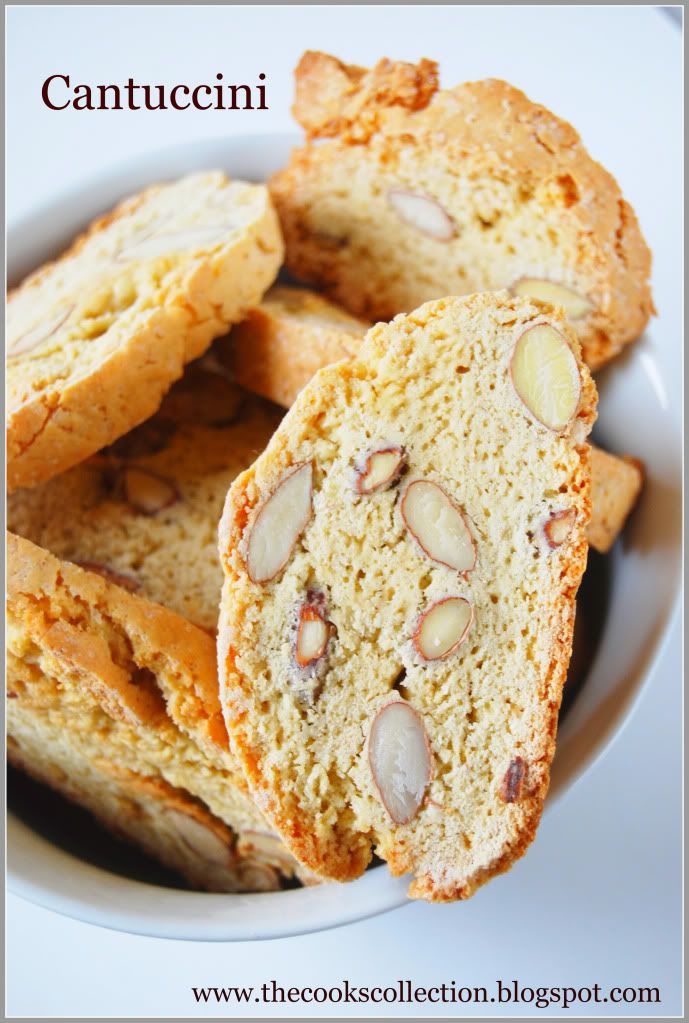
Cantuccini

All Italian cookies are called biscotti, but these are what we think of as classic biscotti. Twice baked cookies, they are first baked in a log shape, then sliced and baked again until they are very dry and crunchy. (Because they contain no butter or other fat, except that contained in the eggs, they can bake to a formidable state of crunchiness.) The techniques used to make can't-stop-eating-them biscotti are, like the cookies themselves, classic.


This post also goes to Meeta's Monthly Mingle : High Tea Treats

Recipe from Nick Malgiri. Adapted from the book "Baking with Julia".

Ingredients:
2 cups all-purpose flour
3/4 cup sugar
2 tsps baking powder
1/2 tsp cinnamon
1/4 tsp salt
1 1/2 cups unblanched whole almonds
3 large eggs
2 tsps pure vanilla extract

Directions:

Position a rack in the center of the oven and preheat the oven to 350 deg F(180 deg C). Line a baking sheet with parchment and keep aside.

Put the sugar, flour, baking powder, cinnamon and salt in a large bowl and stir with a rubber spatula to mix. Stir in the almonds.

Whisk the eggs and vanilla together in a small bowl, then stir them into the flour mixture. The dough may seem dry at this point but it will come together as it is kneaded.

Turn the dough out onto a lightly floured work surface and knead, folding it over onto itself until it is smooth, 1 to 2 minutes. Divide the dough in half and shape each half into 12-inch-long log. Gently press down on the logs to flatten them until they are about 2 inches wide and 1 inch high. Transfer them to the prepared pan.

First baking
Bake the logs for about 30 minutes, or until they are slightly risen and firm to touch. Slide the logs, parchment paper and all, off the baking sheet and onto a cooling rack. The logs must be completely cool before you continue with the recipe. Since they will take about 30 minutes to cool, you can either turn the oven off or leave it on for the next step. You can bake the biscotti up to this point several days ahead. Wrap the logs well in plastic and continue when its convenient.

Second baking
When the logs have cooled completely, preheat the oven to 350 deg F(180 deg C), if necessary. Line 2 baking sheets with parchment paper.
Working with a sharp serrated knife, cut the cooked logs diagonally into 1/4-inch-thick slices. Place the sliced cookies cut side down on the pans and bake for 10 -15 minutes, or until the biscotti are crisp and golden. Cool on the pans.

Storing
These biscotti will keep for up to a month in an airtight tin or plastic container.

Sunday, September 27, 2009

Homemade Puff Pastry and Vol-au-Vent

Daring Bakers September 2009 Challenge

The September 2009 Daring Bakers' challenge was hosted by Steph of A Whisk and a Spoon. She chose the French treat, Vols-au-Vent based on the Puff Pastry recipe by Michel Richard from the cookbook Baking With Julia by Dorie Greenspan.


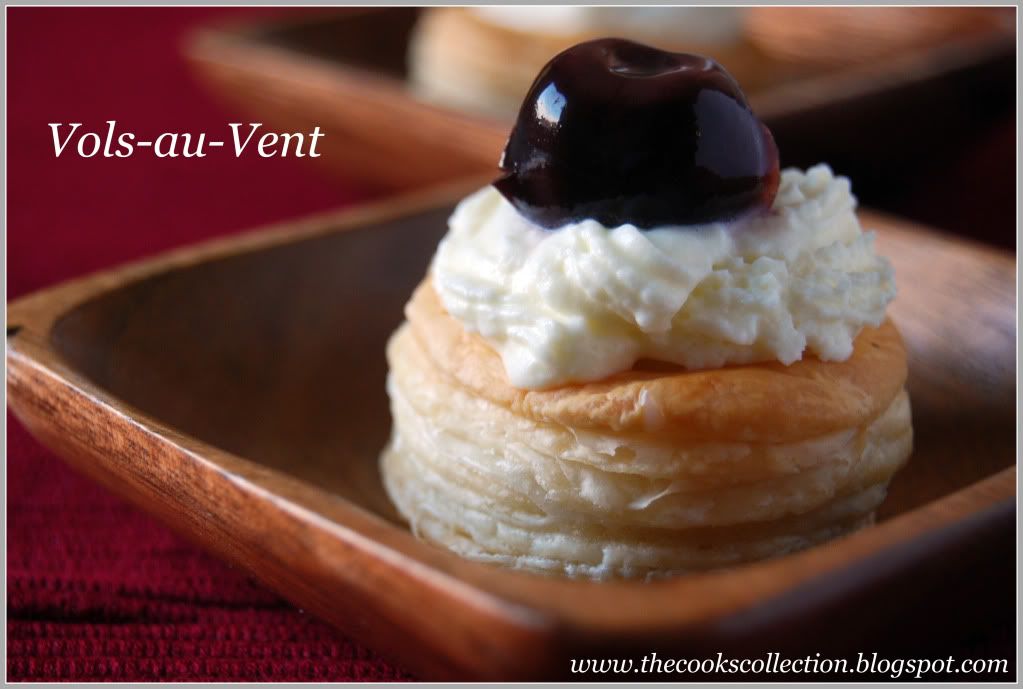
Vol-au-vent filled with pastry cream and topped with sweet whipped cream and sweet cherry. Hmm.. Yummy!!


Michel Richard’s Puff Pastry Dough

From: Baking with Julia by Dorie Greenspan
Yield: 2-1/2 pounds dough

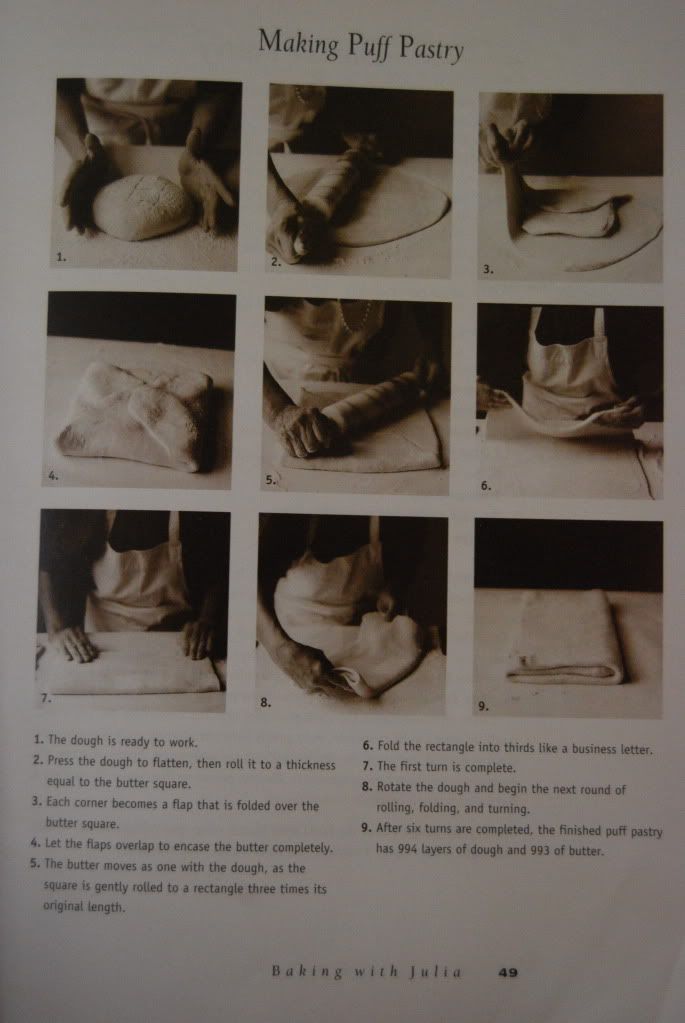
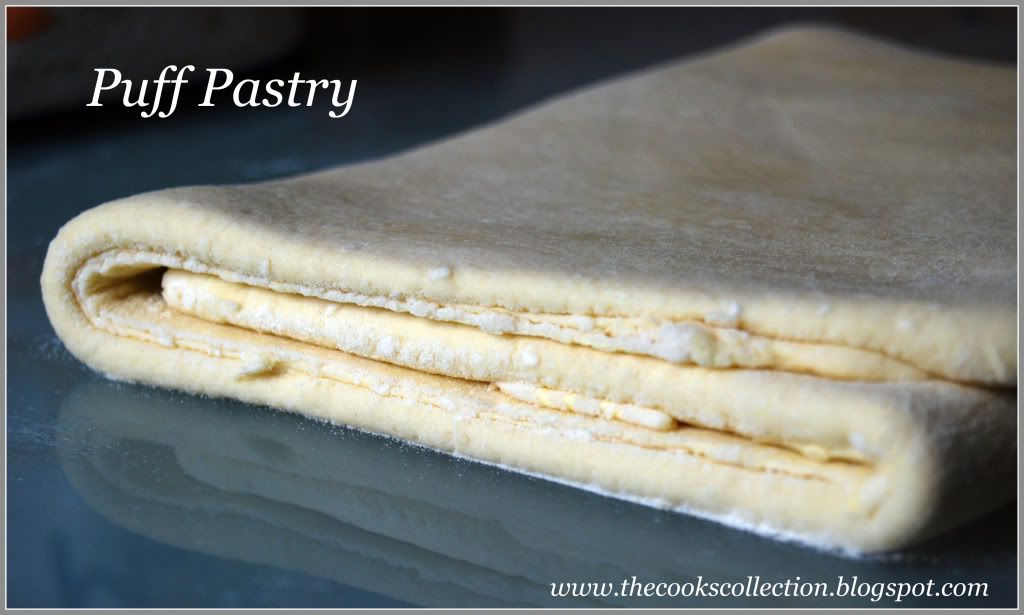
Puff pastry is a quintessential laminated dough. A simple dough is wrapped around a block of butter, then rolled, folded and turned six times, so that when the final dough is baked, it puffs mightily and forms almost one thousand seemingly laminated layers. Puff pastry is called mille feuilles, or "a thousand leaves" in French, but thats an exaggeration. In fact, there are only 944 layers of pastry, seperated by 963 layers of butter, but no matter. This is still the queen of all pastries, the one that, once mastered, entitles you to whatever bragging rights you wish to claim.

Steph’s note:


-This recipe makes more than you will need for the quantity of vols-au-vent stated above. While I encourage you to make the full recipe of puff pastry, as extra dough freezes well, you can halve it successfully if you’d rather not have much leftover.

-Chill early and often - keep the pastry cold and you'll keep the layers.

-Be neat - fold the dough evenly.

-Stay away from the ends - Don't roll over the ends of the pastry or you'll glue the layers together.

-Take your time - don't skimp on the number of turns or the chilling periods.

Ingredients:
2-1/2 cups (12.2 oz/ 354 g) unbleached all-purpose flour
1-1/4 cups (5.0 oz/ 142 g) cake flour (i used 1 cup APF + 1/4 cup cornstarch)
1 tbsp. salt (you can cut this by half for a less salty dough or for sweet preparations)
1-1/4 cups (10 fl oz/ 300 ml) ice water
1 pound (4 sticks/ 16 oz/ 454 g) very cold unsalted butter

plus extra flour for dusting work surface

Extracted From the book "Baking With Julia".

Mixing the Dough:

Check the capacity of your food processor before you start. If it cannot hold the full quantity of ingredients, make the dough into two batches and combine them.

Put the all-purpose flour, cake flour, and salt in the work bowl of a food processor fitted with a metal blade and pulse a couple of times just to mix. Add the water all at once, pulsing until the dough forms a ball on the blade. The dough will be very moist and pliable and will hold together when squeezed between your fingers. (Actually, it will feel like Play-Doh.)

Remove the dough from the machine, form it into a ball, with a small sharp knife, slash the top in a tic-tac-toe pattern. Wrap the dough in a damp towel and refrigerate for about 5 minutes.

Meanwhile, place the butter between 2 sheets of plastic wrap and beat it with a rolling pin until it flattens into a square that's about 1" thick. Take care that the butter remains cool and firm: if it has softened or become oily, chill it before continuing.

Incorporating the Butter:

Unwrap the dough and place it on a work surface dusted with all-purpose flour (A cool piece of marble is the ideal surface for puff pastry) with your rolling pin (preferably a French rolling pin without handles), press on the dough to flatten it and then roll it into a 10" square. Keep the top and bottom of the dough well floured to prevent sticking and lift the dough and move it around frequently. Starting from the center of the square, roll out over each corner to create a thick center pad with "ears," or flaps.

Place the cold butter in the middle of the dough and fold the ears over the butter, stretching them as needed so that they overlap slightly and encase the butter completely. (If you have to stretch the dough, stretch it from all over; don't just pull the ends) you should now have a package that is 8" square.

To make great puff pastry, it is important to keep the dough cold at all times. There are specified times for chilling the dough, but if your room is warm, or you work slowly, or you find that for no particular reason the butter starts to ooze out of the pastry, cover the dough with plastic wrap and refrigerate it . You can stop at any point in the process and continue at your convenience or when the dough is properly chilled.

Making the Turns:

Gently but firmly press the rolling pin against the top and bottom edges of the square (this will help keep it square). Then, keeping the work surface and the top of the dough well floured to prevent sticking, roll the dough into a rectangle that is three times as long as the square you started with, about 24" (don't worry about the width of the rectangle: if you get the 24", everything else will work itself out.) With this first roll, it is particularly important that the butter be rolled evenly along the length and width of the rectangle; check when you start rolling that the butter is moving along well, and roll a bit harder or more evenly, if necessary, to get a smooth, even dough-butter sandwich (use your arm-strength!).

With a pastry brush, brush off the excess flour from the top of the dough, and fold the rectangle up from the bottom and down from the top in thirds, like a business letter, brushing off the excess flour. You have completed one turn.

Rotate the dough so that the closed fold is to your left, like the spine of a book. Repeat the rolling and folding process, rolling the dough to a length of 24" and then folding it in thirds. This is the second turn.

Chilling the Dough:

If the dough is still cool and no butter is oozing out, you can give the dough another two turns now. If the condition of the dough is iffy, wrap it in plastic wrap and refrigerate it for at least 30 minutes. Each time you refrigerate the dough, mark the number of turns you've completed by indenting the dough with your fingertips. It is best to refrigerate the dough for 30 to 60 minutes between each set of two turns.

The total number of turns needed is six. If you prefer, you can give the dough just four turns now, chill it overnight, and do the last two turns the next day. Puff pastry is extremely flexible in this regard. However, no matter how you arrange your schedule, you should plan to chill the dough for at least an hour before cutting or shaping it.


Note on Freezing Puff Pastry

Although puff pastry can be chilled or frozen at any stage, it is really most convenient to give the puff pastry a full six turns, roll it out into a flat sheet, chill it on a parchment-lined baking sheet, and then, when it is cold, wrap it for the freezer. Rolling the dough into a sheet means it will defrost quickly and won't have to be rolled much before you cut and bake it. Thaw the dough, still wrapped, in the refrigerator.

Steph’s extra tips:

-While this is not included in the original recipe we are using (and I did not do this in my own trials), many puff pastry recipes use a teaspoon or two of white vinegar or lemon juice, added to the ice water, in the détrempe dough. This adds acidity, which relaxes the gluten in the dough by breaking down the proteins, making rolling easier. You are welcome to try this if you wish.

-Keep things cool by using the refrigerator as your friend! If you see any butter starting to leak through the dough during the turning process, rub a little flour on the exposed dough and chill straight away. Although you should certainly chill the dough for 30 to 60 minutes between each set of two turns, if you feel the dough getting to soft or hard to work with at any point, pop in the fridge for a rest.

-Not to sound contradictory, but if you chill your paton longer than the recommended time between turns, the butter can firm up too much. If this seems to be the case, I advise letting it sit at room temperature for 5-10 minutes to give it a chance to soften before proceeding to roll. You don't want the hard butter to separate into chuncks or break through the dough...you want it to roll evenly, in a continuous layer.

-Roll the puff pastry gently but firmly, and don’t roll your pin over the edges, which will prevent them from rising properly. Don't roll your puff thinner than about about 1/8 to 1/4-inch (3-6 mm) thick, or you will not get the rise you are looking for.

-Try to keep “neat” edges and corners during the rolling and turning process, so the layers are properly aligned. Give the edges of the paton a scooch with your rolling pin or a bench scraper to keep straight edges and 90-degree corners.

-Brush off excess flour before turning dough and after rolling.

-Make clean cuts. Don’t drag your knife through the puff or twist your cutters too much, which can inhibit rise.

-When egg washing puff pastry, try not to let extra egg wash drip down the cut edges, which can also inhibit rise.

-Extra puff pastry dough freezes beautifully. It’s best to roll it into a sheet about 1/8 to 1/4-inch thick (similar to store-bought puff) and freeze firm on a lined baking sheet. Then you can easily wrap the sheet in plastic, then foil (and if you have a sealable plastic bag big enough, place the wrapped dough inside) and return to the freezer for up to a few months. Defrost in the refrigerator when ready to use.

-You can also freeze well-wrapped, unbaked cut and shaped puff pastry (i.e., unbaked vols-au-vent shells). Bake from frozen, without thawing first.

-Homemade puff pastry is precious stuff, so save any clean scraps. Stack or overlap them, rather than balling them up, to help keep the integrity of the layers. Then give them a singe “turn” and gently re-roll. Scrap puff can be used for applications where a super-high rise is not necessary (such as palmiers, cheese straws, napoleons, or even the bottom bases for your vols-au-vent)

Forming and Baking the Vols-au-Vent

Yield: 1/3 of the puff pastry recipe below will yield about 8-10 1.5” vols-au-vent or 4 4” vols-au-vent

-egg wash (1 egg or yolk beaten with a small amount of water)
-your filling of choice

Line a baking sheet with parchment and set aside.

Using a knife or metal bench scraper, divided your chilled puff pastry dough into three equal pieces. Work with one piece of the dough, and leave the rest wrapped and chilled. (If you are looking to make more vols-au-vent than the yield stated above, you can roll and cut the remaining two pieces of dough as well…if not, then leave refrigerated for the time being or prepare it for longer-term freezer storage. See the “Tips” section below for more storage info.)

On a lightly floured surface, roll the piece of dough into a rectangle about 1/8 to 1/4-inch (3-6 mm) thick. Transfer it to the baking sheet and refrigerate for about 10 minutes before proceeding with the cutting.

(This assumes you will be using round cutters, but if you do not have them, it is possible to cut square vols-au-vents using a sharp chef’s knife.) For smaller, hors d'oeuvre sized vols-au-vent, use a 1.5” round cutter to cut out 8-10 circles. For larger sized vols-au-vent, fit for a main course or dessert, use a 4” cutter to cut out about 4 circles. Make clean, sharp cuts and try not to twist your cutters back and forth or drag your knife through the dough. Half of these rounds will be for the bases, and the other half will be for the sides. (Save any scrap by stacking—not wadding up—the pieces…they can be re-rolled and used if you need extra dough. If you do need to re-roll scrap to get enough disks, be sure to use any rounds cut from it for the bases, not the ring-shaped sides.)

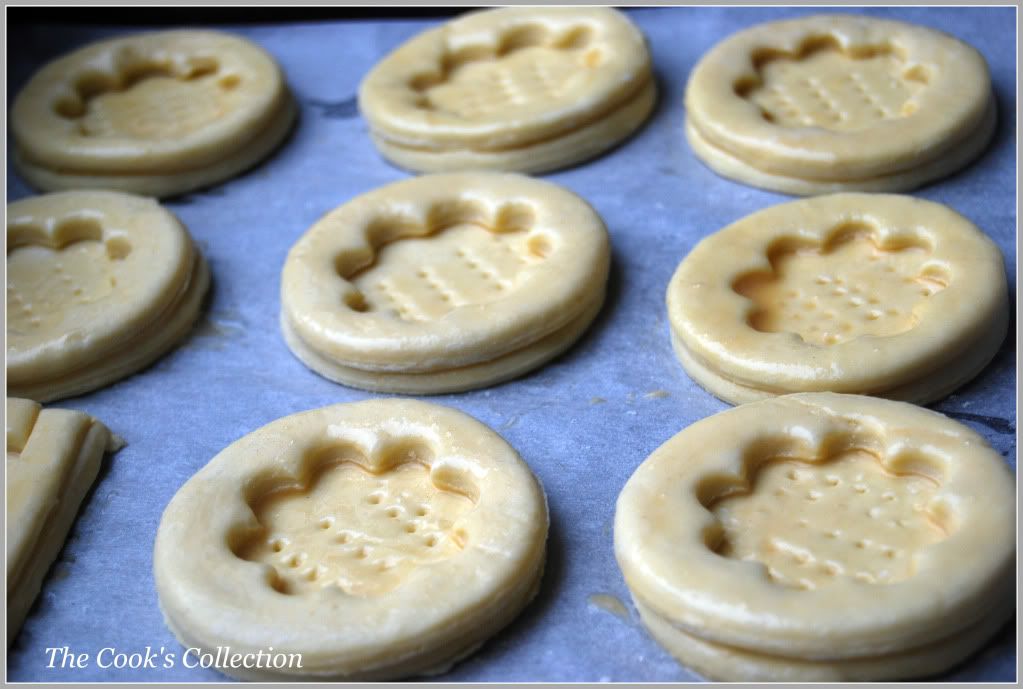
Using a ¾-inch cutter for small vols-au-vent, or a 2- to 2.5-inch round cutter for large, cut centers from half of the rounds to make rings. These rings will become the sides of the vols-au-vent, while the solid disks will be the bottoms. You can either save the center cut-outs to bake off as little “caps” for you vols-au-vent, or put them in the scrap pile.

Dock the solid bottom rounds with a fork (prick them lightly, making sure not to go all the way through the pastry) and lightly brush them with egg wash. Place the rings directly on top of the bottom rounds and very lightly press them to adhere. Brush the top rings lightly with egg wash, trying not to drip any down the sides (which may inhibit rise). If you are using the little “caps,” dock and egg wash them as well.

Refrigerate the assembled vols-au-vent on the lined baking sheet while you pre-heat the oven to 400ºF (200ºC). (You could also cover and refrigerate them for a few hours at this point.)


Once the oven is heated, remove the sheet from the refrigerator and place a silicon baking mat (preferred because of its weight) or another sheet of parchment over top of the shells. This will help them rise evenly. Bake the shells until they have risen and begin to brown, about 10-15 minutes depending on their size. Reduce the oven temperature to 350ºF (180ºC), and remove the silicon mat or parchment sheet from the top of the vols-au-vent. If the centers have risen up inside the vols-au-vent, you can gently press them down. Continue baking (with no sheet on top) until the layers are golden, about 15-20 minutes more. (If you are baking the center “caps” they will likely be finished well ahead of the shells, so keep an eye on them and remove them from the oven when browned.)

Remove to a rack to cool. Cool to room temperature for cold fillings or to warm for hot fillings.


Fill and serve.

*For additional rise on the larger-sized vols-au-vents, you can stack one or two additional ring layers on top of each other (using egg wash to "glue"). This will give higher sides to larger vols-au-vents, but is not advisable for the smaller ones, whose bases may not be large enough to support the extra weight.

*Although they are at their best filled and eaten soon after baking, baked vols-au-vent shells can be stored airtight for a day.

*Shaped, unbaked vols-au-vent can be wrapped and frozen for up to a month (bake from frozen, egg-washing them first).

Tuesday, September 8, 2009

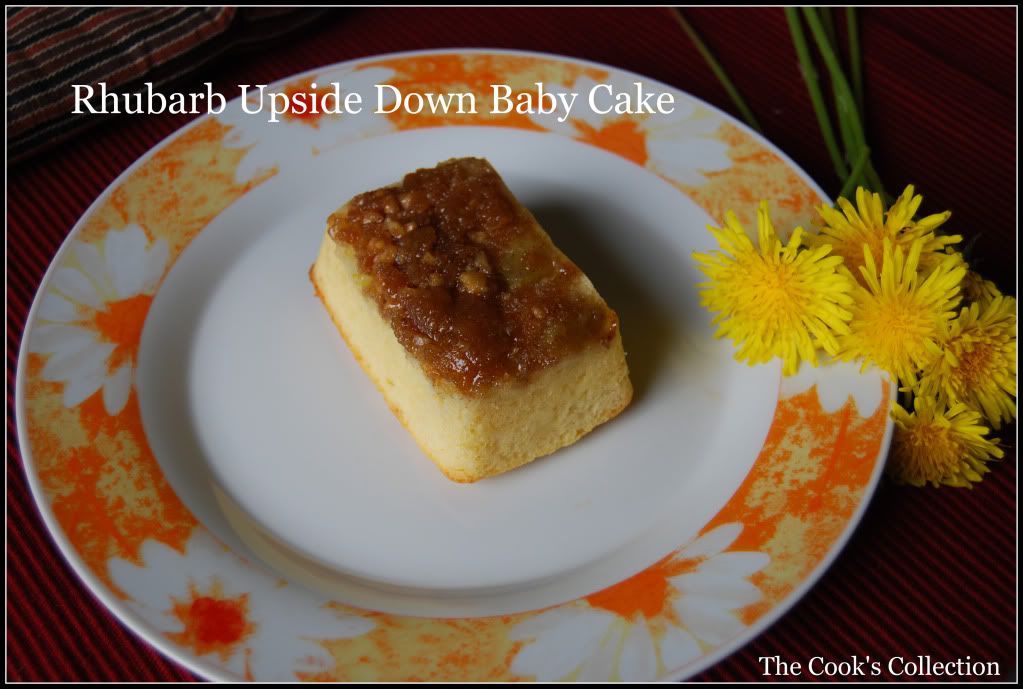
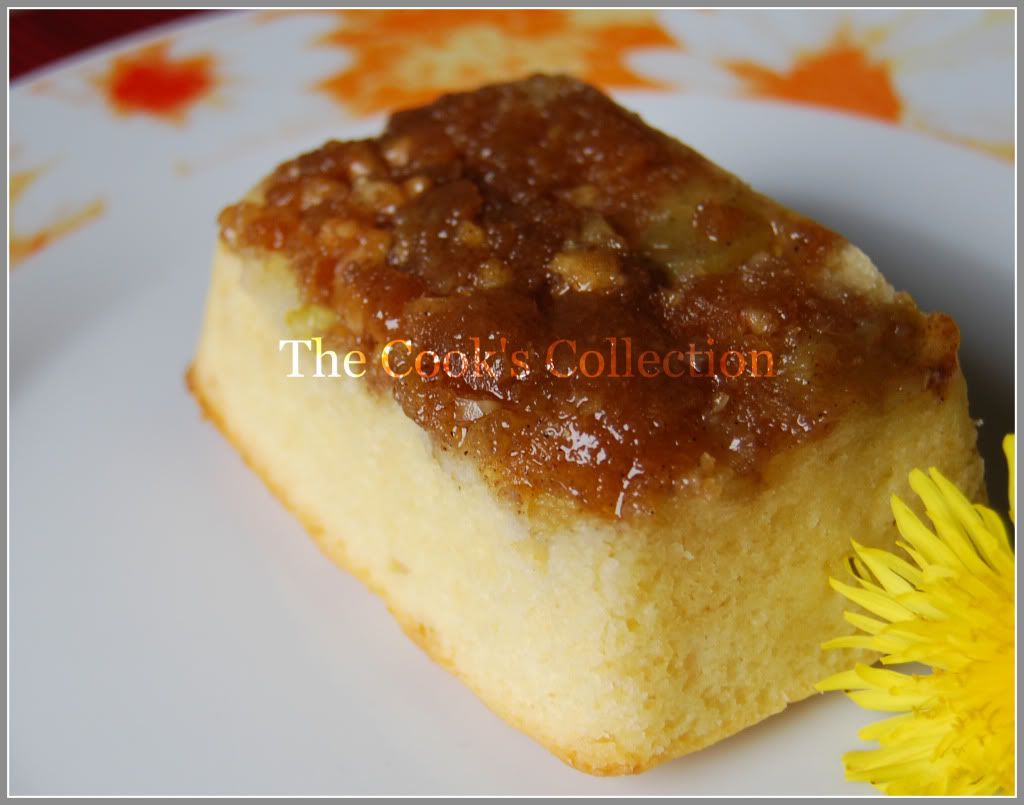
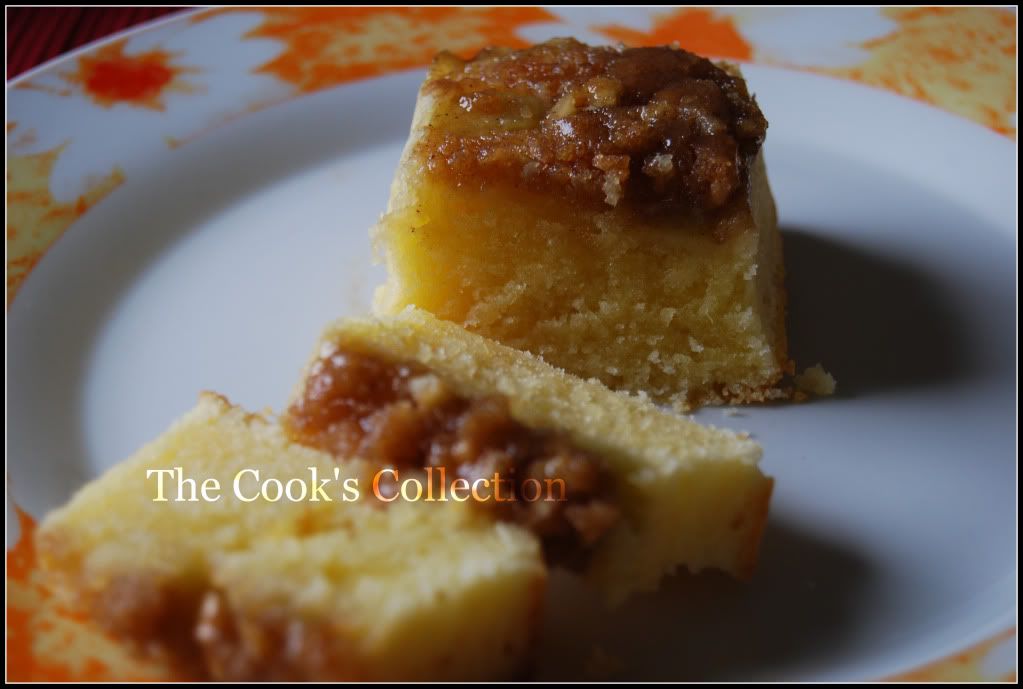
Fresh Rhubarb Upside-down Baby Cakes


Here's a tender, soft-crumbled butter cake, a classic of the genre, made as individual upside-down cakes. The baby cake pans, each four inches across, are lined with a mixture of melted butter, brown sugar, and pecans and decorated with slices of Rhubarb before the bourbon-boosted butter cake batter is poured in. In fact, there's nothing sacred about Rhubarb; you can vary the fruit as you choose. Try using mangoes, apples or pears, apricots, plums, or bananas, and vary the liqueur or flavoring to match the fruit.

If the urge to bake these lovely cakes strikes and you haven't a set of baby cake pans at hand, make these in muffin tins or custard cups, or make the recipe as one large cake. The batter is perfect for an eleven- or twelve-inch cast iron skillet or a twelve-inch round cake pan, and turned out, the large cake is impressive.

These baby cakes, as well as the Hazelnut baby loaves, Vanilla pound cake, are members of the same large and universally appealing family, the butter cake clan.

Recipe adapted from "Baking With Julia"

You'll be needing the following ingredients..

1 2/3 cup all purpose flour
2 tsps baking powder
1 tsp salt
2 tsp pure vanilla extract
1 cup creme fraiche, homemade or store bought, or sour cream
1 1/2 sticks (6 ounces) unsalted butter, at room temperature
1/2 cup(lightly packed) brown sugar
1 tbsp bourbon
2 tbsps chopped pecans
6 to 7 stalks (12 ounces) fresh Rhubarb, trimmed and cut into 1/4-inch-thick-slices
1 cup granulated sugar
2 large eggs, at room temperature

Melted butter for greasing the pans
Lightly sweetened whipped cream, for serving(optional)

Here we start..

Position a rack in the center of the oven and preheat the oven to 35o deg F. Brush the insides of 8-mini or baby cake pans, each 4 inches across and 1 inch deep, with a light coating of melted butter, dust the flour and tap out the excess. Whisk or stir the flour, baking powder, and salt together just to blend;reserve. In a separate bowl, stir the vanilla into the creme fraiche and set aside until needed.
Melt the 1/2 stick butter in a heavy skillet. Add the brown sugar and bourbon and cook over medium heat, stirring with wooden spoon until the sugar melts. Stir in the pecans to coat with the caramel and turn of the heat. Divide the caramel evenly among the pans, working quickly to get it to the edges of the pan before it sets( cooked sugar cools rapidly). Arrange the rhubarb in circles over the sugar, and set aside while you make the batter.
Put the remaining stick of butter and the granulated sugar in the bowl of a mixer fitted with the paddle attachment, or use a hand-held mixer, and beat on medium-high speed until the mixture is smooth and creamy, scrapping down the sides of the bowl with a rubber spatula as needed. The butter and sugar must be beaten until they're light, fluffy, and pale, so don't rush it- the process can take 3 to 4 minutes with a heavy duty mixer and 6 to 8 minutes with a hand-held mixer. Reduce the speed to medium and add the eggs one at a time, beating well after each addition.
Working with a rubber spatula, carefully fold in the dry ingredients and the creme fraiche alternately- 3 additions of dry ingredients, 2 of the creme fraiche. You'll end up with a thick batter.

Baking the cakes Spoon the batter over the rhubarb and smooth the tops by rotating the pans while you run the rubber spatula over the batter. Put the pans on a jelly role pan and bake for 20 to 25 minutes, or until a toothpick inserted in the center of a cake comes out clean. (Test couple of cakes to be certain.) As soon as the cakes are removed from the oven, turn them out of their pans on to a rack.

Serve with whipped cream if desired.

Storage The cakes can be kept wrapped in plastic at room temperature overnight.

Tuesday, May 12, 2009

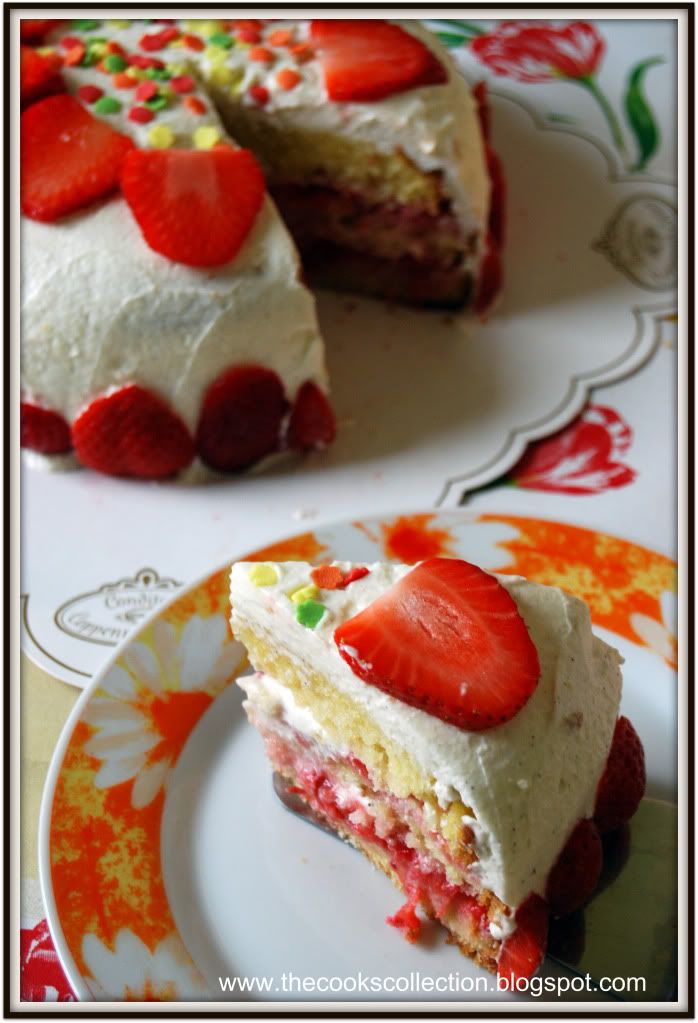
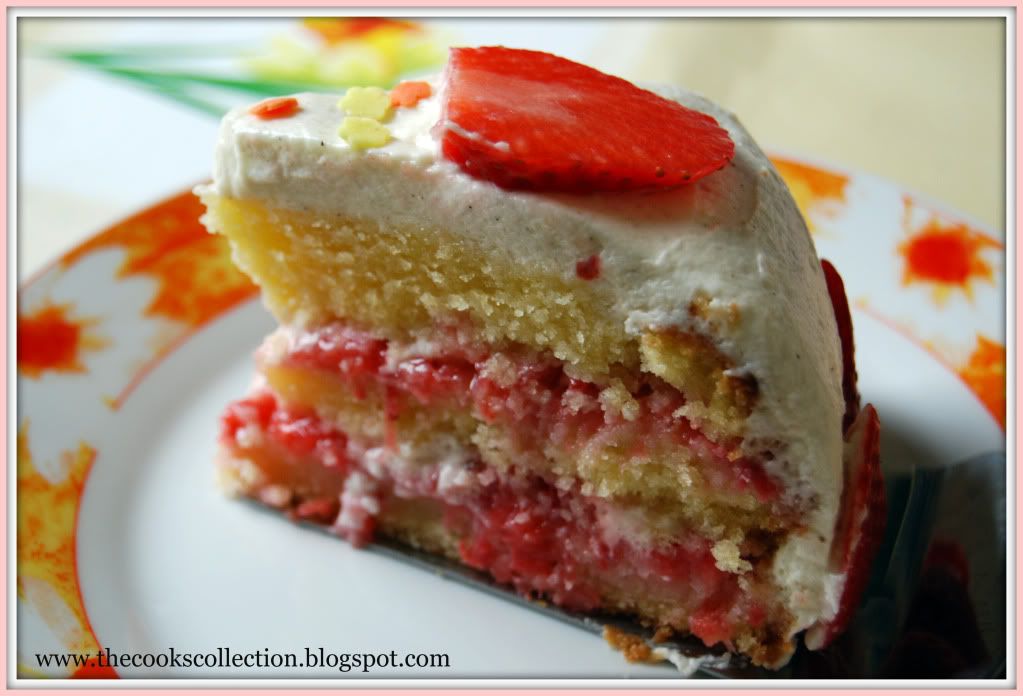
Layered Strawberry Cake

This Strawberry cake is basically a pound cake which is layered with sweet, tangy, juicy and colorful sugared berries and a velvety blend of whipped sweet cream, finished with the same cream and topped with fresh berries. The berry filling and the cream mixture can be used with any Genoise cake or any other plain vanilla cake.


I present this Strawberry cake to Meeta's Monthly Mingle - Spring Cakes!

This recipe is adapted and altered from "Baking With Julia".

The ingredients used for this recipe are:

For the cake
1 1/2 cups all-purpose flour
1 tsp baking powder
1/4 tsp salt
1 stick (4 ounce),115 gms butter, at room temperature
1 cup sugar
2 large eggs, at room temperature, whisked to blend
1/2 cup milk, at room temperature
1 tsp pure vanilla extract

For the Strawberry filling
1 pint (2 cups) ripe fresh strawberries, hulled and sliced
1/4 cup sugar (depending on the sweetness of the fruit)

For the cream
1 1/4 cups cold heavy cream
2 tbsps sour cream
2 tbsps sugar
1 tsp pure vanilla extract

Position a rack in the lower third of the oven and preheat the oven to 350 deg F(180 deg C). Butter and flour a 7 inch round pan.

For the cake Sift the flour, baking powder, and salt together onto a sheet of waxed or parchment paper. Reserve.
Put the butter into the bowl of a mixer fitted with the paddle attachment(or work with a hand-held mixer) and beat at medium speed until smooth. With the machine running, add the sugar in a steady steam. Stop the machine and scrap down the paddle and the sides of the bowl with a rubber spatula. Continue to beat at medium speed until the mixture is very light and fluffy, about 4 to 5 minutes.
With the mixer still at medium speed, begin to add the eggs in small addition, about a tablespoon at a time. If the mixture becomes watery or shiny, stop adding the eggs and beat at an increased speed just until it smooths out. When the batter has come together again, decrease the speed to medium and continue adding the eggs, scraping down the paddle and sides of the bowl from time to time; it will take 3 to 4 minutes to incorporate the eggs. The mixture is properly combined when it appears white, fluffy, and increased in volume.
Reduce the mixer speed to low and add the flour mixture and the milk alternately--4 additions of flour, 3 of milk-- scraping the paddle and bowl frequently and mixing until the batter is smooth after each addition. Add the vanilla and mix just to blend.

Baking the cake Spoon the batter into the prepared pan and smooth the top with a spatula. Bake for 55 to 65 minutes, or until a wooden toothpick inserted in the center of the cake comes out clean. Transfer the cake to a cooling rack and allow it to cool in the pan for 10 minutes. Invert the cake onto a rack, remove the pan, and cool to room temperature.

Preparing the Berries Toss the sliced berries with the sugar in a large bowl and leave them uncovered, at room temperature for at least 2 hours.
Coarsely mash the berries with the tines of the fork and toss them again; let them stand for 1 hour longer. You can do this the day before, but the berries should be refrigerated after they are mashed.

For the cream Using a mixer fitted with the whisk attachment or a hand held mixer, whip the heavy cream, sour cream, sugar and vanilla together until the mixture forms soft peaks. The cream is the proper consistency when the tracks made by the whisk close slowly and almost disappear. Cover and refrigerate the cream, give it a turn or two by hand with a whisk to bring the mixture together again.

Finishing the cake Using a serrated knife and a gentle sawing motion, cut the cake horizontally into 3 layers. Pace the bottom layer cut side up on a cardboard round and the removable bottom of a tart pan. Lifting the berries from the bowl with a slotted spoon so that most of the liquid drains of, spoon half of the mashed strawberries over the cake layer, then spread a thin layer of the whipped cream over the berries. Top with the middle layer, spoon on the rest of the strawberries, and spread another thin layer of the cream over the berries. Center the top layer over the filling.
Working with a flexible metal icing spatula, frost the top and sides of the cake with whipped cream and decorate as you wish with strawberries or with some icing left out. Refrigerate the cake for at least an hour before serving.

Storing The cake can be refrigerated for several hours before serving. Keep it away from the foods in the refrigerator with strong odors, as cream picks up odors quickly. It would be ideal if you could store this cake in a box.

Tuesday, April 14, 2009

Sweet Ricotta Pie

This dessert uses pasta frolla, a sweet Italian pie dough for the base and lattice. The filling used here in this recipe can be made in minutes. It uses just 5 ingredients and Anisette, a licorice-flavoured liqueur, is the traditional flavouring for this type of cheese cake, but you can use anise extract or alter the flavour completely by substituting vanilla or almond extract, using brandy, or mixing in a little fruit-flavoured liqueur, such as Grand Marnier.

I made a mini version of this recipe as i had to serve just 2 people. I reduced the recipe into half (reduced all the ingredients for filling by half and used just 1 large egg) and used 4 mini tart molds instead of a large one. I loved this dessert as it has a light cheese filling and a crisp cookie feel base. I freezed half the recipe of pasta frolla and will be using it for other recipes.

Recipe adapted from "Baking With Julia"

Ingredients required;

1 pound, OR 450 gms whole milk ricotta
1/3 cup sugar, ( i added a little extra for the sweetness)
1 tbsp anisette or 1 tbsp vanilla extract
3 large eggs, beaten
1/2 tsp cinnamon

1 recipe Pasta Frolla

Method;

Stir in ricotta, sugar, anisette, and eggs together in a bowl until smooth; set aside.

Position a rack in the lower third of the oven and preheat the oven to 350 deg F. Butter a 9-inch glass pie plate. (If you dont have a glass pie plate, use metal, but increase the oven temperature to 375 deg F.) (I used mini tart molds)

Working with 2/3 rd of the dough, knead it into a disc and roll it on a lightly floured work surface into a 12 inch circle. Transfer the dough to the pie plate and press it gently against the bottom and up the sides of the plate. Dont worry if the dough tears-just press it back together. Use the dull side of the knife to trim the excess dough even with the rim. Srape the filling into the pie shell, smooth the top, and dust with cinnamon.

Forming the lattice
Knead and shape the remaining piece of dough into a block and roll it on a lightly floured surface into a 9-inch square. Using a pizza or pastry cutter ( a ruffle-edged pastry wheel is nice) or a thin sharp knife, cut the dough into 12 even strips. To form the lattice top, lay 6 of the strips across the pie at 1 1/4 inch intervals, then crisscross with the remaining strips, placing them diagonally across the first strips. Trim the ends of the lattice even with the edge of the pan.

Baking the Pie
Bake for 35 to 40 minutes, or until the crust is golden and the filling is firm and slightly puffed. Transfer the pie to a rack and cool completely before serving.

Storing ;
Leftovers can be kept, well covered in the refrigerator, for up to 3 days. Serve slightly chilled or at room temperature.

Pasta Frolla

Pasta frolla - pasta means "paste" or "dough" amd frolla means "tender" - is a sweet Italian pie dough. It is indeed tender, light and crumbly too, and a crust as commendable with savory fillings as with sweet such as Sweet Ricotta Pie. Its a made-in-the-food-processor dough thats's almost indestructable. And because of relatively large amount of sugar, you dont have to worry about overworking it, nor do you need to be concerned if it cracks as it goes into the pie plate - everything is fixable.

Makes enough for a 9-inch lattice -topped pie

You'll need the following Ingredients...

2 cups all-purpose flour
1/3 cup sugar
1/2 tsp baking powder
1/4 tsp salt
1 stick (4 ounces) cold unsalted butter or 4 ounces cold lard, cut into 8 pieces
2 large eggs, lightly beaten

Method

Put the flour, sugar, baking powder, and salt into the work bowl of a food processor fitted with metal blade; pulse a few time just to mix the ingredients. Add the butter and pulse 15 to 20 minutes, or until the mixture resembles fine cornmeal. With the machine running, add the eggs and process until the dough forms a ball on the blade, about a minute or so. Remove the dough from the food processor and knead it, folding it over on itself, until it is smooth, 1 to 2 minutes. Wrap the dough in plastic and set aside for up to 30 minutes, or chill until needed.

Storing
The dough can be made up to 3 days ahead, wrapped well, and refrigerated, or frozen, tightly wrapped, for up to a month. Thaw , still wrapped, in the refrigerator.

Try this recipe with Sweet Ricotta Pie.

Tuesday, March 24, 2009

Buttermilk Scones

Makes 12 triangular or 24 rolled scones

Think of scones as British biscuits. They are made in a manner similar to biscuits and, in fact, share biscuits' buttery-layered texture, but their name, their shape, and the fact that they're served with tea rather than gravy lift them to the level of fancier fare.
Here are scones two ways: the traditional triangle and the rolled--tender buttermilk dough rolled around chopped fruits, nuts, and/or jam. Whichever way you choose, they're luscious: à la the British, with tea and whipped cream, or served the American way, with coffee and a gloss of jam.

These scones had a very thin crisp outer crust and a soft, flaky and moist bread/cake like inner crumb. Rolled scones were a nice idea as they already had jam filled in and no other accompanyment was required. These scones can be served as a great snack along with coffee or tea.


This post is my contribution to Egg Substitute - Yogurt/Buttermilk Event , an event hosted by Madhuram of Eggless Cooking.

Recipe adapted from "Baking with Julia" by Dorie Greenspan.

Ingredients required:

3 cups all-purpose flour
1/3 cup sugar (i added plus 1/4 cup)
2 1/2 tsps baking powder
1/2 tsp baking soda
3/4 teaspoon salt
1 1/2 sticks (6 ounces) cold unsalted butter, cut into small pieces
1 cup (approximately) buttermilk
1 tablespoon grated orange or lemon zest

1/2 stick (2 ounces) unsalted butter, melted, for brushing
1/4 cup sugar, for dusting

4 tablespoons jam or jelly and/or 4 tablespoons diced or small plump dried fruits, such as currants, raisins, apricots, or figs, for filling (optional)

Here we start..

Position the oven racks to divide the oven into thirds and preheat the oven to 425 deg F (220 deg C).

Mixing and Kneading:
In a medium bowl, stir the flour, sugar, baking powder, baking soda, and salt together with a fork. Add the cold butter pieces and, using your fingertips (the first choice), a pastry blender, or two knives, work the butter into the dry ingredients until the mixture resembles coarse cornmeal. It's OK if some largish pieces of butter remain--they'll add to the scones' flakiness
Pour in 1 cup buttermilk, toss in the zest, and mix with the fork only until the ingredients are just moistened--you'll have a soft dough with a rough look. (If the dough looks dry, add another tablespoon of buttermilk.) Gather the dough into a ball, pressing it gently so that it holds together, turn it out onto a lightly floured work surface, and knead it very briefly--a dozen turns should do it. Cut the dough in half.

To make triangular shaped scones:
Roll one piece of the dough into a 1/2-inch-thick circle that is about 7 inches across. Brush the dough with half of the melted butter, sprinkle with 2 tablespoons of the sugar, and cut the circle into 6 triangles. Place the scones on an ungreased baking sheet and set aside while you roll out the rest of the dough.

To make rolled scones:
Roll one piece of dough into a strip that is 12 inches long and 1/2-inch-thick (the piece will not be very wide). Spread the strip with half of the melted butter and dust with half of the sugar. If you want to spread the roll with jam and/or sprinkle it with dried fruits, now's the time to do so; leave a narrow border on a long edge bare. Roll the strip up from a long side like a jelly roll; pinch the seam closed and turn the roll seam side down. Cut the roll in half and cut each piece into six 1-inch-wide roll-ups. Place the rolled scones cut side down on an ungreased baking sheet, leaving a little space between each one. Repeat with the remaining dough.

Baking the scones:
Bake the scones for 10 to 12 minutes, until both the tops and bottoms are golden. Transfer the scones to a rack to cool slightly. These are best served warm but are just fine at room temperature.


Storing:
If you're not going to eat the scones the day they are made, wrap them airtight and freeze; they'll stay fresh for a month. To serve, defrost the scones at room temperature in their wrappers, then unwrap and reheat on a baking sheet for 5 minutes in a 350 degree F oven.

Tuesday, March 3, 2009

Hazelnut Baby Loaves

These small loaf cakes develop a thin, light, sugary crust and a soft, tender inner crumb due to the addition of cream to the batter. The loaves are beautifully flavoured and scented with ground hazelnuts. They taste lovely as it is without any accompanyment.


Recipe from Baking with Julia


You'll need the following ingredients..

1/3 cup hazelnuts, peeled (see below)
1 cup sugar
1 2/3 cup all-purpose flour
2 tsps baking powder
1 tsp salt
1/2 tsp pure almond extract ( vanilla will do..)
1 cup creme fraiche, homemade or store-bought, OR
heavy cream, at room temperature
1 stick(4 ounces, nearly 100 gms) unsalted butter, at room temperature
2 large eggs, at room temperature

Melted butter, for greasing the pans
little flour for dusting the pans

Here we go..

To skin the hazelnuts, bring a cup of water to a boil in a medium saucepan, add 1/2 a tsp of baking soda and the nuts, and boil for 3 to 5 minutes, until the water turns black. To test if the skins have loosened sufficiently, drop a nut into a bowl of cold water and rub lightly against the skin. if the skin just slides off,the nuts are ready to go. Turn the nuts into a colander and run cold water over them. Slip off the skins, toss the nuts into a towel, pat dry, and use as required.


Position the rack in the center of the oven and preheat the oven to 350 deg F(180 deg C). Brush a light coating of butter over the insides of 8 mini-loaf pans, each 4 1/4 by 2 1/2 by 2 inches. Dust the inside of the pan with a little flour and tap out the excess.

Place the hazelnuts and 1 tbsp of sugar in a mixer or processor and just process until the nuts are finely ground, taking care not to overdo this or you'll end up with hazelnut butter. Its absolutely fine if its not totally ground. Whisk or stir together the ground hazelnuts, flour, baking powder, and salt just to combine; set aside.

In a separate bowl, add the almond extract to the creame fraiche and stir to blend and loosen the creme fraiche; reserve.

Put the butter and the remaining sugar in the bowl of a paddle attachment, or use a hand-held mixer, and beat on a medium-high speed until the mixture is smooth and creamy, scarping down the sides of the bowl with a rubber spatula as needed. The butter and sugar must be beaten until they are light, fluffy, and pale, so dont rush it- the process can take 3 to 4 minutes with a heavy-duty mixer or 6 to 8 minutes with a hand-held mixer.

Reduce the speed to medium and add the eggs one at a time, beating well after each addition.

Divide the batter evenly among the prepared pans, filling the pans between half and two-thirds full, then give each pan a couple of raps against the countertop to settle the batter.


Place the pans in the oven and bake for about 30 minutes, or until a toothpick inserted in the center of a cake comes out clean. (Test a couple of the cakes to be certain.) Remove from the oven, turn them out of their pans onto a rack and cool.


The loaves can be served warm or at room temperature. Serve one loaf to a person, either slicing the loaves in half diagonally or cutting them into thin slices.


Storage: The cakes can be kept covered at room temperature for about 2 days or wrapped airtight and frozen for a month. Thaw still wrapped, at room temperature.

Tuesday, January 6, 2009

White Loaf

This is a basic, have-it-on-hand-at-all-times white bread with a difference--its got full, rounded flavor and a substantial texture; not your average sandwich loaf. And it makes great toast-the little bit of butter browns nicely under heat. Its got a crunchy crust and very softy inside.


Makes 1 Loaf

Ingredients:
1 1/4 cups warm water
1/2 tbsp Active dry yeast
1/2 tbsp sugar
3 1/2 cups bread flour or all purpose flour
1/2 tbsp Salt
1/4 stick butter(1 ounce) unsalted butter, at room temperature

Method:

Mixing and kneading; Pour 1/4 cup of water into a large bowl. Sprinkle in the yeast and sugar, and whisk to blend. Allow the mixture to rest until the yeast is creamy, about 5 minutes.

Sift the flour and salt together. Add the remaining 1 cup of water and half of the flour to the yeast and start mixing it with a wooden spatula. Add the remaining flour and start working with your hands till the dough comes together(if the dough does not come together, add a bit more flour, a tablespoon at a time). Work until the dough is smooth and elastic. Knead it with your hands on a lightly floured surface for 8 to 10 minutes.

When the dough is thoroughly mixed, add the butter, a tablespoon at a time and knead until incorporated. Dont be disconcerted if the beautiful dough comes apart with the addition of butter-kneading will bring it back together.

First rise; Turn the dough onto a lightly floured surface and shape it into a ball. Place it in a large buttered or oiled bowl and turn the dough around to cover its entire surface with butter or oil. Cover and let the dough rest at room temperature until it doubles in bulk, about 45 minutes to 1 hour.
During winter switch the oven to max for 2 minutes and swich it off. Place a bowl of boiling water in the bottom of the oven and place the bowl with the dough in the center rack. Close the oven and let it rise.

Shaping the dough; Butter a loaf pan and set aside.
Deflate the dough and turn it onto a lightly floured work surface. Roll the dough into a rectangle. With the short side facing you, start rolling the dough and seal the seam by pinching it. Drop the loaf into the pan, seam side down.


Second Rise; Place the loaf in a warm place covered with a loose oiled plastic wrap until they double in size again growing over the tops of the pan about 45 minutes.


Baking the bread; Center a rack in the oven and preheat the oven to 375 deg F. When the loaf has fully risen, bake for 35 to 45 minutes or until they are honey brown. Cool completely before cutting.


Storing; Once completely cool, the bread can be kept in a brown paper bag for a day or two. Once the loaf is sliced,turn it cut side down on a cutting board and cover with a kitchen towel. For longer storage, wrap the bread airtight and freeze for upto a month. Thaw still wrapped at room temperature.

Tuesday, December 16, 2008

Galette Dough

The cornmeal in this dough makes the galette a crisp, crunchy and sturdy enough to be rolled to extreme thinness. You can use this dough to line tart pan, but it s particularly well suited to rustic tarts called galette- flat, free form tarts whose edges are folded over the filling like ruffled top of a drawstring purse.
The dough is made quickly either by hand or in a food processor and produces enough for two galettes.

Adapted from Baking with Julia

Makes enough for two 8-inch galettes

Ingredients

3 tbsp sour cream (or yogurt or buttermilk)
1/3 cup (approximately) ice water
1 cup All purpose flour
1/4 cup Cornmeal
1 tsp Sugar
1/2 tsp Salt
7 tbsps cold unsalted butter, cut into 6 to 8 pieces

TO MAKE THIS DOUGH BY HAND, stir the sour cream and 1/3 cup ice water together in a small bowl and set aside. Pour the flour, cornmeal, sugar and salt in a large bowl and stir with a fork to mix. Drop the butter pieces into the bowl, tossing them just once or twice just to coat them with flour. With a pastry blender or using two knifes, work the butter into the flour, aiming for pieces of butter that range in size from bread crumbs to small peas. The smaller pieces will make the dough tender, the larger ones will make it flaky.
Sprinkle the cold sour mixture over the dough, 1 tablespoon at a time, tossing with a fork to evenly distribute it. After you've added all of your sour cream, the dough should be moist enough to stick together when pressed; if its not, add additional cold water, 1 teaspoon at a time. With your hands gather the curds of dough together. (You'll have a soft, malleable dough, the kind you might want to overwork.)

Chilling the dough; Turn the dough out of the bowl and divide it in half. I made 4 parts so that i could try 4 different galettes. Press each piece of dough into a disc, wrap in plastic and refrigerate for at least 2 hours.

TO MAKE THE DOUGH IN A FOOD PROCESSOR, stir the sour cream and 1/3 cup ice water together in a small bowl; set aside. Put the flour, cornmeal, sugar, and salt in a work bowl of a food processor fitted with the metal blade; pulse to combine. Drop the butter pieces into the bowl and pulse 8 to 10 times, or until the mixture is speckled with pieces of butter that vary in size from bread crumbs to peas. With the machine running, add the sour cream mixture and process just until the dough forms soft, moist curds.

Chilling the dough Remove the dough from the processor, divide it in half and press wach half into a disk. Wrap in plastic and chill for atleast 2 hours.

Storing; The dough can be kept in a refrigerator for a day or two, or it can be wrapped airtight and frozen for a month. Thaw, still wrapped, in a refrigerator. It is convenient to roll the dough into rounds, place parchment between each round, and freeze them wrapped in plastic; this way, you'll need only about 20 minutes to defrost a round of dough at room temperature before it can be filled, folded into a galette, and baked.

Tuesday, December 2, 2008

Semolina Bread

Golden semolina flour gives this bread a warm, sunny color, a tender crumb and a nutty taste. Semolina loaves are often associated with Italian baking-perhaps because semolina flour is milled from durum wheat, the flour used to make pasta. I've just given a twist to the bread by spreading a layer of cinnamon and brown sugar into the bread. Even the plain loaf tastes good as well..

Adapted from Baking with Julia and altered by me.


Makes 1 loaf

THE SPONGE

1 Cup warm water (about 110 deg F)
1 tsp Active dry yeast
1 tsp Sugar
1 Cup All-purpose flour

Pour the warm water into a medium bowl and whisk in the yeast and the sugar. When the yeast has dissolved and is creamy, about 5 minutes, stir in the flour.

Rise; Cover the bowl and let it rest at room temperature until the sponge doubles in volume, about 2 hours.

THE DOUGH

The sponge (above)
1/2 to 3/4 Cup All purpose flour
3/4 Cup Semolina flour
1 tsp Salt
1 tbsp Olive oil

METHOD

Grease a loaf pan with little butter and keep side.

Take the sponge in a large bowl. Add 1/2 cup of the all purpose flour and rest of the ingredients and work with your hands till the dough forms a ball. If the dough doesn't come together in a ball, add another 1/4 cup of all purpose flour, mixing a tablespoon at a time. Take the dough on a lightly floured surface and knead for 5 to 10 minutes.

First rise; Turn the dough into an oiled bowl, cover the bowl with plastic wrap and let the dough rest at room temperature until it doubles in volume.
In this cold weather you can use the oven method to give the dough a rise. Just switch on the oven to max for 2 minutes and switch it off. Now take a bowl of boiling water and place it in the bottom rack of the oven. Now place the bowl with the dough in the middle rack and close the oven. let it stand for about and hour or so.. you can see that the dough would have raised beautifully.

Shaping and second rise; Deflate the dough and turn it on to a floured surface. Flatten it with your palms and pat the dough into a rough oval shape and then roll it from one long side to the other, to form a plump loaf. Tuck the ends under and transfer it into the prepared loaf pan and allow it to rest until it doubles in bulk again, about 2 hours.


Baking the bread; Preheat the oven to 400 deg F( 200 deg C).

Bake for about 35 mintes, until deeply golden. Transfer the bread to a rack and cool completely before cutting.


Variation; To create the sweet layer in between, just mix in 1/4 Cup of brown sugar and a tsp of Cinnamon and chopped nuts if you prefer. Spread a tbsp of softened butter before rolling the dough in for the second rise and spread the cinnamon and sugar mixture. Then follow the given steps.


Storing; The bread can be kept at room temperature for a day; cover it loosely with plastic wrap. For longer storage, wrap it airtight and freeze for up to 1 month. Thaw, still wrapped, at room temperature.

Tuesday, November 4, 2008

Finnish pulla

Like broiche and challah, Finnish pulla is a butter and egg rich bread. Although it can be served at any time, it is often a celebration loaf. The traditional flavouring for a pulla is cardamom, which is invariably lackluster.

Adapted from Baking with Julia

You'll need the following ingredients..
1 cup Milk
1 tbsp Active dry yeast
1/4 cup warm water(about 110 deg F)
1/2 cup Sugar
1 tsp Crushed cardamom seeds(from about 7 pods)
1 tsp Salt
2 large eggs, lightly beaten, at room temperature
4 1/2 to 5 cups All purpose flour (unbleached)
1 stick Unsalted butter, melted

For Glaze
1 large egg beaten with 1 tbsp milk

For topping
Sliced almonds
Pearl sugar

Method
Put the milk in a small saucepan and scald it(heat it until a ring of small bubbles is visible around the sides of the pan). Remove the pan from the heat and cool the milk to a room temperature of between 105 deg F and 115 deg F.

In a large bowl, whisk the yeast into the warm water. Set aside for 5 minutes, or until the yeast has dissolved and is creamy. Whisk in the milk, sugar, cardamom, salt and eggs. Switch to a wooden spoon, add 2 cups of flour, and beat the mixture until smooth. Beat in the butter and add as much additional flour, 1/2 cup at a time, as you can until the dough is stiff but not dry.

Cover the bowl with plastic wrap and allow the dough to rest for 15 minutes.

Turn the dough out onto a lightly floured work surface and knead until it is smooth and satiny, about 10 minutes.

Shape the dough into a ball. Place it in a lightly greased bowl, turn it around in the bowl to grease the top, and cover the bowl tightly with plastic wrap. Let the dough rise at room temperature until it doubles in bulk, 45 minutes to 1 hour. You can use the method for raising the dough in winter which is given in my layered rolls recipe.

Line a large baking sheet with parchment paper and set aside

Turn the dough out onto the oiled surface and knead it lightly and briefly, just to deflate it and release the air. Divide the dough into thirds and roll each third into a rope of about 36 inches long. Braid the three strands(refer my challah recipe), braiding as far down to the bottom of the strands as you can. lift the long braid onto the parchment-lined pan, shaping it into a circle as you place it on the pan. Snip about 1 inch of dough off each end of the braid and fuse the ends together, pressing ans pinching them (if necessary) to fit.

Cover the wreath with a kitchen towel and allow it to rise at room temperature until it is puffy but not doubled, about 45 minutes.

Center a rack in the oven and preheat the oven to 375 deg F(190 deg C).

Brush the egg glaze over the bread. Sprinkle the wreath with sliced almonds and pearl sugar.

Bake for 20 to 25 minutes, until golden, taking care not to over bake the wreath. Transfer the loaf to a rack to cool at room temperature before cutting.


Storing:
The bread will keep for a day at room temperature, lightly covered with plastic. If you want to keep the bread longer, wrap it air tight ans freeze it for upto 1 month. Thaw, still wrapped, at room temperature.

About Us | Site Map | Privacy Policy | Contact Us | Blog Design | 2007 Company Name